12.21.25Notes on Peripheral Vision and the Athlete
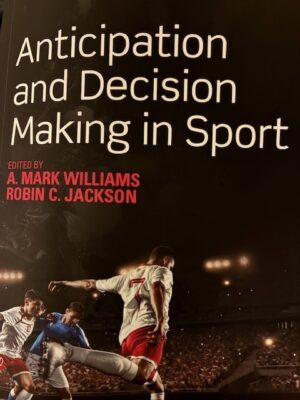
I’m continuing to work my way through Williams & Jackson’s “Anticipation and Decision Making in Sports. It’s excellent but dense and technical –“I read it so you don’t have to”–so here are some takeaways from the very useful Chapter Five, by Christian Vater et al: “The Role of Peripheral Vision in Sports and Everyday Life.”
Vater et al: “Foveal vision is characterized by high motion sensitivity and high spatial acuity, though within a very small area (the central 2-3 degrees of visual angle). Peripheral vision…is characterized by high motion sensitivity bit low acuity, which is reduced by 50% at 5 degrees from center and 90% at 40% from the gaze point.”
DL Notes:
- Peripheral vision is imprecise (often highly so) and designed to recognize motion [or light] and draw foveal vision as needed. Foveal vision is powerful but expensive. To lock in fully on the foveal is often to tune out the peripheral.
- We almost always overestimate the acuity of our peripheral vision because it subsequently draws our foveal gaze and we then (fractions of a second later) se it clearly. But in fact the acuity of our peripheral vision is more akin to looking through a frosted shower door.
Vater et al: “Peripheral vision assists in the stabilization of posture…and can be used to help locate obstacles in the environment that should be avoided during locomotion. However the ability to perceive targets in the periphery is affected by attentional demands [ie WM sensitive].”
In traffic, novice drivers use foveal vision more and peripheral vision less. This implies that expertise involves the capacity to extract useful information from peripheral vision without having to shift to foveal vision. The need to focus on an object comes at a cost. Shifting to foveal vision when peripheral will do is a common novice’s flaw. “Anchoring location” is very important.
“In defensive situations, where intermediates and especially novices fixated [on] the opponent’s arms and fists, expert boxers mostly fixated [on] the opponent’s head, indicating the use of peripheral vision to process information from the opponent’s arms and hands. The experts mainly switched gaze between the head and the trunk )i.e. the opponent’s central body axis). In contrast, intermediates switched gaze between the head and the arms or the trunk and the arms. The scan pattern of novices did not differ from that of intermediates but [was] even less organized such that the gaze was sometimes even located on the pelvis or the legs. These transition patterns reflect and “economical” visual search behavior for an optimized use of peripheral vision…by experienced boxers.”
DL Notes:
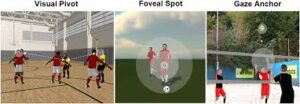
Pivots: “points receiving more fixations of shorter durations”
Anchors: points “with fewer fixations of longer duration.”
Gaze anchor is the place your eyes rest to optimize the benefits of peripheral vision until you know where to fixate.
Vater et al: Anchoring is “the long fixation on a specific location between [often] cues that is relevant for the main task. Gaze anchoring could help a) to monitor multiple cues at the same time or to switch attention between cues [more efficiently].”
Predictive saccades are glances we make to focus our foveal (high quality) vision on a certain point, often before something happens there and because we guess or predict that it will.
“Peripheral vision can be used to monitor players in the periphery, process motion-related information of other players or the ball, and to select the location of the next fixation….Pursing gaze-anchoring strategies is generally advisable in order to optimally exploit peripherally available information.” Where you rest your eyes when you don’t yet know what will happen or where you’ll need to focus is also very very important.
Process, per Vater et al:
“Gaze anchoring” [resting eyes in optimal location] leads to “covert monitoring” [attending to cues in peripheral vision] leads to “peripheral preview” (the location of the next fixation] leads to “predictive saccade” [your eyes flash there probably confirming forst tht your guess of “importance” was right before fully focusing on the object (and implicitly tuning other things out more) …
DL hypothesis: We could divide the predictive saccade into two groups: 1) “confident”: you are locking in on something because you are predicting it will become momentarily important you have bet on looking there. 2) “ambiguous”: you are playing for time and do not yet want to commit a saccade to an object of foveal focus. You want to continue a non-foveal neutral gaze point to play for time but you still move your location of gaze (gaze anchor) to respond to changing cues, context and movement. Occasionally you flick (“pivot) to other pints to monitor more closely but you are not locking in
Other DL Notes Applications and Takeaways:
- “Optimal gaze anchoring location” is almost assuredly a marker of expertise.
- If you get better at covert monitoring [using peripheral vision] you don’t have to bet as early and as heavily with your foveal vision (and risk the non foveal blindness that always comes with it).
- You can shift attention within your field of vision to at least some degree: Vater et al: “Experts should be able to predetermine important players and monitor their actions covertly and in parallel.”
- Information from peripheral vision seems to be used for selecting the location of the next fixation, suggesting a preview functionality.
- Experts often locate their gaze “to a predictive location where no information is available on the fovea” ie a neutral or central location with little inherent value of its own—example… goalkeepers look at a point between knee and foot to monitor ball strike and leg movement even though there is little information at the shin per se.
- Gaze anchoring is sometimes not geographically central to objects being covertly monitored. Experts often orient closer to one they think more likely to accelerate a potential foveal shift to that point.
